Front Description
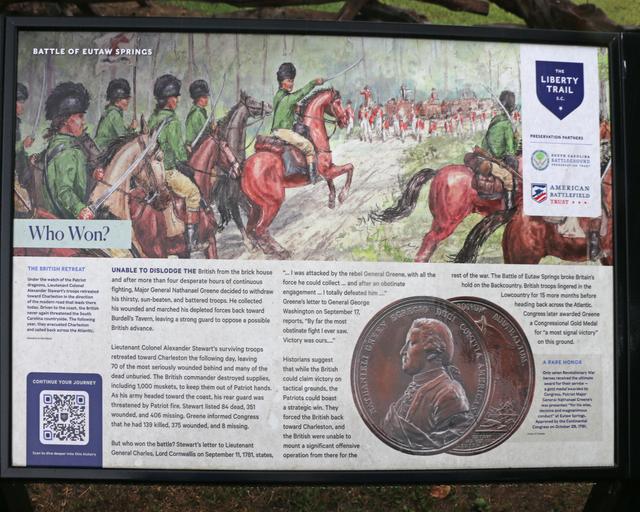
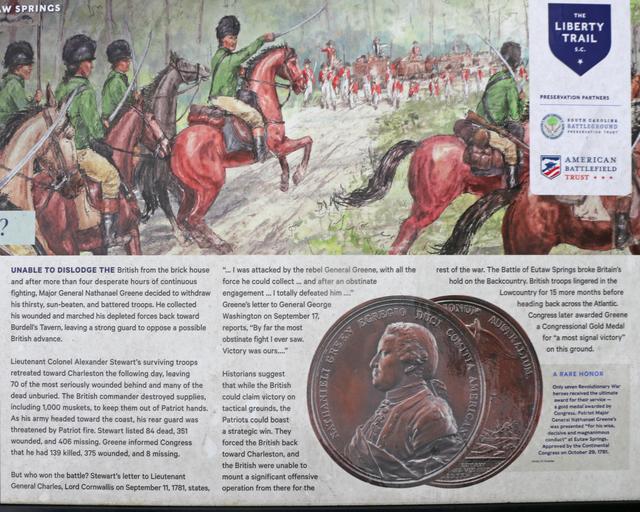
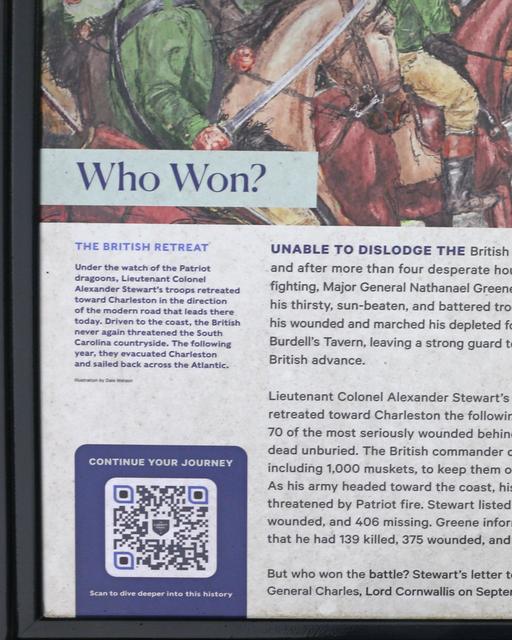
Unable to dislodge the British from the brick house and after more than four desperate hours of continuous fighting, Major General Nathanael Greene decided to withdraw his thirsty, sun-beaten, and battered troops. He collected his wounded and marched his depleted forces back towards Burdell’s Tavern, leaving a strong guard to oppose a possible British advance.
Lieutenant Colonel Alexander Stewart’s surviving troops retreated towards Charleston the following day, leaving 70 of the most seriously wounded behind and many of the dead unburied. The British commander destroyed supplies, including 1,000 muskets, to keep them out of Patriots hands. As his army headed toward the coast, his rear guard was threatened by Patriot fire. Stewart listed 84 dead, 351 wounded, and 206 missing. Greene informed Congress that he had 139 killed, 375 wounded and 8 missing.
But who won the battle? Stewart’s letter to Lieutenant General Charles, Lord Cornwallis on September 11, 1781, states, “….I was attacked by the rebel General Greene, with all the force that he could collect – and after an obstinate engagement – I totally defeated him….” Greene’s letter to General George Washington on September 17, reports, “By far the most obstinate fight I ever saw. Victory was ours…”
Historian suggest that while the British could claim victory on tactical grounds, the Patriot could boast a strategic win. They forced the British back towards Charleston, and the were unable to mount a significant offensive operation from there for the rest of the war. The Battle of Eutaw Springs broke Britian’s hold on the Backcountry. British troops lingered in the Lowcountry for 15 more months before heading back across the Atlantic. Congress later awarded General Greene a Congressional Gold Medal for “a most signal victory” on this ground.
Site Photos