Front Description
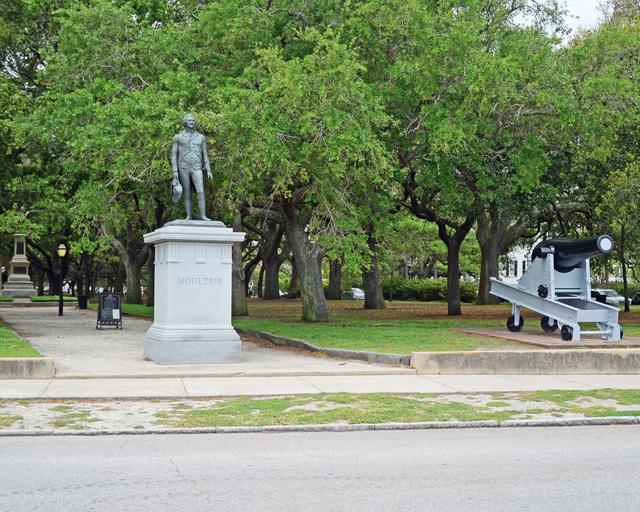
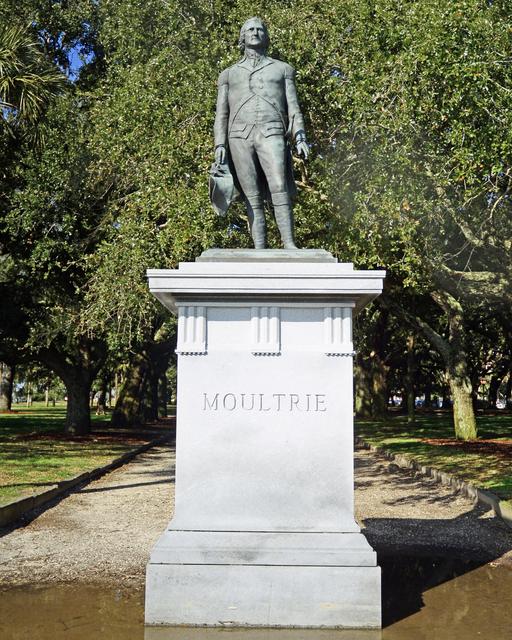
Moultrie
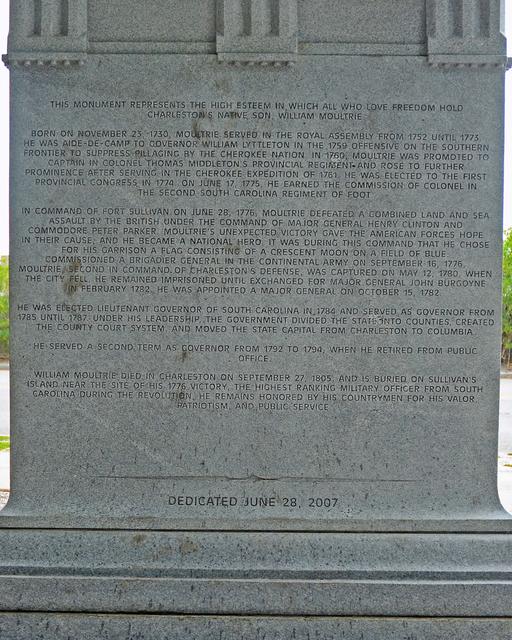
This Monument represents the high esteem in which all who love freedom hold Charleston’s native son, William Moultrie
Born November 23, 1730, Moultrie served in the Royal Assembly from 1752 until 1773. He was Aide-de-Camp to Governor William Lyttleton in the 1759 offensive on the southern frontier to suppress pillaging by the Cherokee Nation. In 1760, Moultrie was promoted to captain in Colonel Thomas Middleton’s Provincial Regiment and rose to further prominence after serving in the Cherokee Expedition of 1761. He was elected to the First Provincial Congress in 1774. On June 17, 1775, he earned the commission of Colonel in the Second South Carolina Regiment of Foot.
Back Description
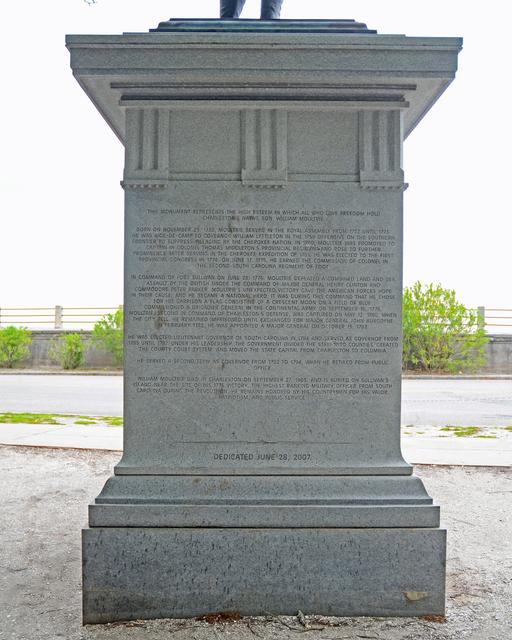
In command of Fort Sullivan on June 28, 1776, Moultrie defeated a combined land and sea assult by the British under the command of Major General Henry Clinton and Commodore Peter Parker. Moultrie’s unexpected victory gave the American forces hope in their cause, and he became a national hero. It was during this command that he chose for his garrison a flag consisting of a crescent moon on a field of blue.
Commissioned a Brigadier General in the Continental Army on September 16, 1776. Moultrie, second in command of Charleston’s defense, was captured on May 12, 1780, when the city fell. He remained imprisoned until exchanged for Major General John Burgoyne in February 1782. He was appointed a Major General on October 15, 1782.
He was elected Lieutenant Governor of South Carolina in 1784 and served as Governor from 1785 until 1787. Under his leadership, the government divided the state into counties, created the County Court System, and moved the State Capital from Charleston to Columbia.
He served a second term as Governor from 1792 to 1794, when he retired from public office.
William Moultrie died in Charleston on September 27, 1805 and is buried on Sullivan’s Island near the site of his 1776 victory. The highest ranking military officer from South Carolina during the Revolution, he remains honored by his countrymen for his valor, patriotism and public service.
Site Photos