Front Description
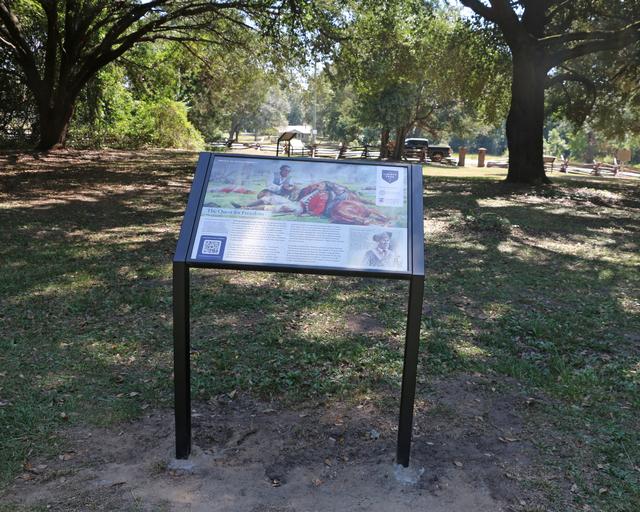
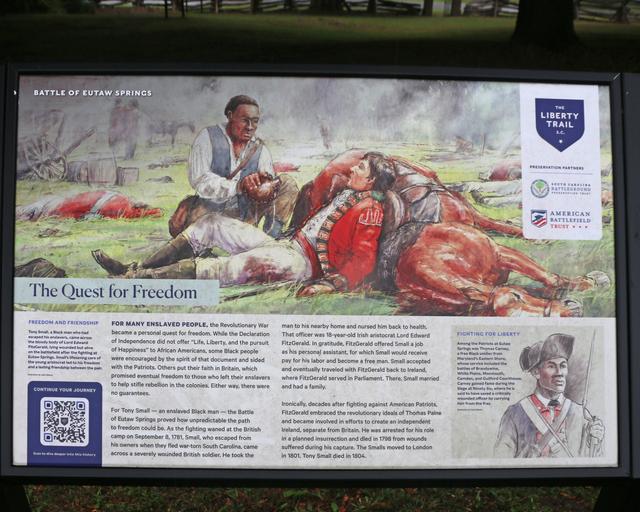
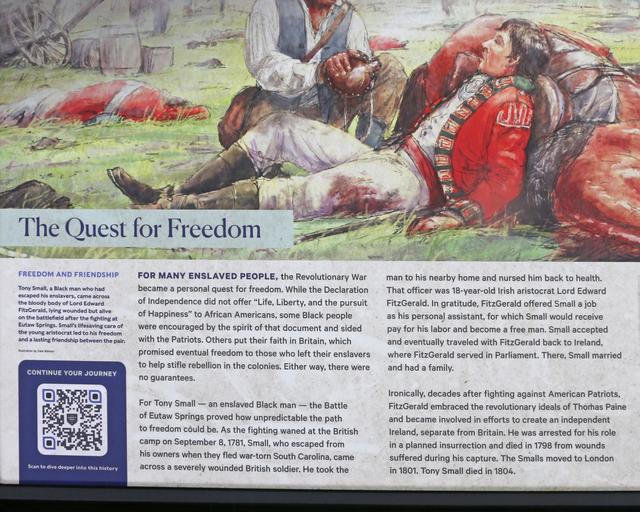
For many enslaved people, the Revolutionary War became a personal quest for freedom. While the Declaration of Independence did not offer “Life, Liberty and the pursuit of Happiness” to African American, some Black people were encouraged by the spirit of that document and sided with the Patriots. Others put their faith in Britain, which promised eventual freedom to those who left their enslavers to help stifle rebellion in the colonies. Either way, there were no guarantees.
For Tony Small – an enslaved Black man – the Battle of Eutaw Springs proved how unpredictable the path to freedom could be. As the fighting waned at the British camp on September 8, 1781, Small, who escaped from his owners when they fled war-torn South Carolina, came across a severely wounded British soldier. He took the man to his nearby home and nursed him back to health. That officer was 18-year-old Irish aristocrat Lord Edward FitzGerald. In gratitude, FitzGerald offered Small a job as his personal assistant, for which Small would receive pay for his labor and become a free man. Small accepted and eventually traveled with FitzGerald to Irland where FitzGerald served in Parliament. There, Small married and had a family.
Ironically, decades after fighting against American Patriots, FitzGerald embraced the revolutionary ideas of Thomas Paine and became involved in efforts to create an independent Ireland, sperate from Britain. He was arrested for his role in a planned insurrection and died in 1798 from wounds suffered during his capture. The Smalls moved to London in 1801, Tony Small died in 1804.
Site Photos