Front Description
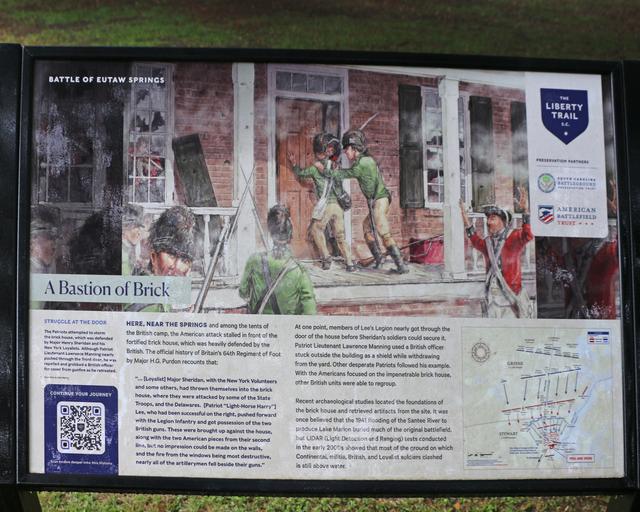
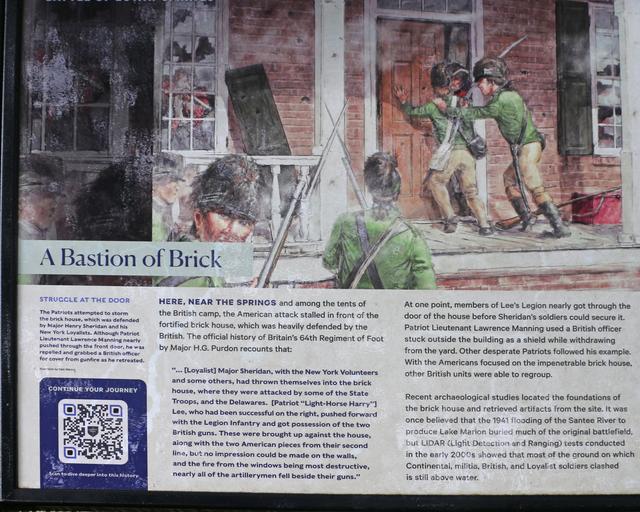
Here, near the springs and among the tents of the British camp, the American attack stalled in front of the fortified brick house, which was heavily defended by the British. The official history of Britain’s 64th Regiment of Foot by Major H.G. Purdon recounts that: “…[Loyalist] Major Sheridan, with the New York Volunteers and some others, had thrown themselves into the brick house, and the Delawares. [Patriot “Light-Horse Harry Lee”] Lee, who had been successful in the right, pushed forward with the Legion Infantry and got possession of the two British guns. These were brought up against the house, along with the two American pieces from their second line, but no impression could be made on the walls, nearly all of the artillerymen fell beside their guns.”
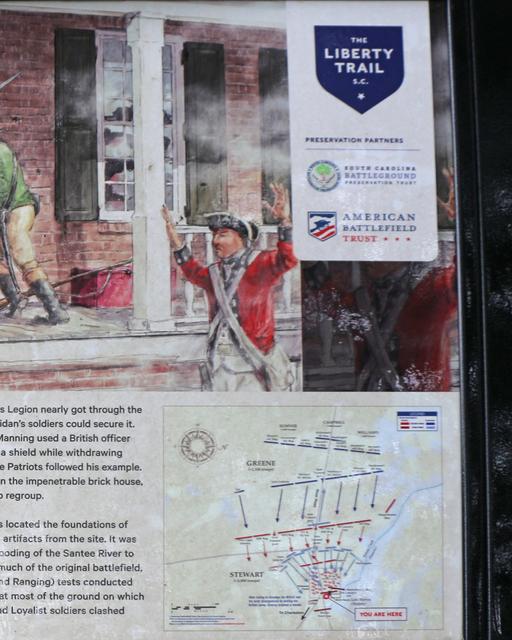
At one point, members of Lee’s Legion nearly got through the door of the house before Sheridan’s soldiers could secure it. Patriot Lieutenant Lawerence Manning used a British office stuck outside of the building as a shield while withdrawing from the yard. Other desperate Patriots followed his example. With the American focused on the impenetrable brick house, other British units were able to regroup.
Recent archaeological studies located the foundations of the brick house and retrieved artifacts from the site. It was once believed that the 1941 flooding of the Santee River to produce Lake Marion buried much of the original battlefield, but LIDAR (Light Detection and Ranging) tests conducted in the early 2000s showed that most of the ground on which Continental, militia, British, and Loyalist soldiers clashed is still above water.
Site Photos